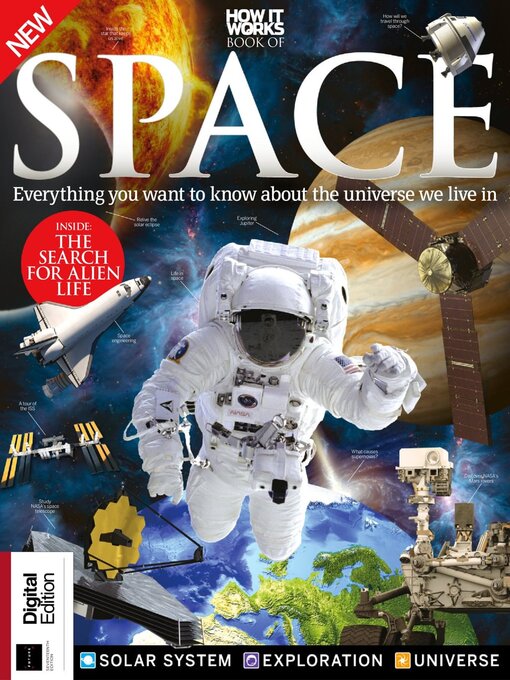
Space has fascinated mankind from the earliest days of civilisation, and as we keep scratching the surface of the vast universe in which we live, our sense of awe and wonder continues to grow unabated. Now, with the technological advancements being made by the world’s space agencies, we understand more than ever about the things that are happening beyond our own planet. This new edition of the How It Works Book of Space has been updated with more of the latest astronomical advancements, stunning space photography, and glimpses at what the future of space exploration holds. Taking you from the heart of our Solar System and out into deep space. Get ready for lift off and discover the depths of our universe and beyond with extreme cosmic temperatures, parallel universes and known active galaxies.
Welcome to HOW IT WORKS BOOK OF SPACE
How It Works: Book Of Space, 17th Ed
Earth • From astronaut snaps taken with handheld cameras to advanced satellite imagery that enables us to predict natural disasters, discover the planet as you’ve never seen it before
ESA’s Envisat • The European Space Agency’s environmental satellite (Envisat) was launched into a polar orbit on 1 March 2002. Its instruments are used to study the ocean, agriculture, ice formations and atmospheric conditions of Earth.
NASA’s Terra satellite • Launched on 18 December 1999, Terra (EOS AM-1) investigates the impact of natural and man-made climate changes. It travels in a north-to-south, near-polar orbit at an altitude of 705km (438mi), viewing the entire surface of the Earth every two days
Inside the Sun • The giant star that keeps us all alive…
It’s the Sun, but not as we know it • These amazing images of the Sun are the first taken by NASA’s Solar Dynamics Observatory (SDO). Taken on 30 March 2010, this false colour image traces the different gas temperatures with reds relatively cool (about 60,000 Kelvin or 107,540 F), while blues and greens are hotter (1 million Kelvin or 1,799,540 F). The SDO provides images with clarity ten times better than high-definition TV.
Solar eclipse • Solar eclipses occur when the Moon passes between the Earth and the Sun
When the Moon blocks out the Sun • The relationship between the Sun, Moon and Earth during an eclipse is geometric
All about the Moon • It took a walk on the Moon to reveal our natural satellite’s many secrets
Mercury • Compared to the other planets, we know relatively little about the smallest planet in our Solar System
Venus • Discover just how similar this planet actually is to Earth…
Mars • Other than the fact that it’s a planet in our Solar System, what do we really know about Mars?
Jupiter • We take a look inside the most massive planet in our Solar System
Saturn • Only Jupiter is larger than this gas giant, best known for its ring system
Uranus • The seventh planet from the Sun, third-largest and fourth most massive in the Solar System, Uranus was the first planet to be discovered by telescope
Neptune • The smallest and coldest of the four gas giants, as well as the most distant from the Sun, Neptune is the windiest planet in our Solar System
Pluto • The elusive Planet X that became an ex-planet and still has many X factors
Europa • Our greatest chance of finding life is possibly on this moon of Jupiter
Life on Titan • Is there life among the chaotic, carbon-based chemistry of this ice-cold world?
Future space tech on Titan • The autonomous technology that NASA hopes will solve many of Titan’s mysteries
Could we survive on Titan?
Engineering a template for life • See the cellular design that could thrive in the harsh conditions on Titan
Dwarf planets • What is a dwarf planet and how is...